
A bathroom, thirty degrees Celsius, hair straightener in hand.
I start this story in an unusual place, detached from the throttled and fueled growls of a fiery racecar, because the death of an industry doesn’t start in a boardroom — rather, it begins in the palm of my hand as I search YouTube for something more stimulating than another episode of Sex and the City.
While media and literature are often deeply elaborate in construction, this usually isn’t the case for consumption. I’m reminded of this every time I straighten my hair; in avoiding the idea of staring into myself in the mirror as my features merge in a fluid depiction of humanness, I’ll often idly run a YouTube video or podcast episode on Spotify to give myself something to think about, besides the occasional sizzle of a strand. This time, I’m looking for anything thoughtful on Formula One, and as I scroll through about twelve videos on the ‘Generational Talent of Oscar Piastri’ and ‘Why We Need Less US-Based Grands Prix’, I resolve that I won’t find what I’m looking for today. Or tomorrow.
This was a confirmation of a worrying diagnosis, a virus of the most contagious sort; Formula One is suffering from a terminal deconstruction of journalism and media in an era of the ‘global audience’.
Terminal is the trite, monotonous, formulaic chants of thirty YouTubers who video-essay why ‘Monaco Needs to Go’, with a scattering of different graphics being the only point of differentiation. Terminal is the self-proclaimed ‘F1 girly’ on TikTok, ranking WAG paddock outfits as she preaches how to be the next Lissie Mackintosh with an aesthetised collage of Pinterest images. I acknowledge that not all media is like this, but for every contemplative piece I come across that forces me to really think, I see about five other articles that tell me why Red Bull is being too harsh on their drivers.
So I get to running the iron against my hair in silence, punctuated with hisses of damage on damp strands. But it’s not truly all quiet, because I’m sorting through the appearances of the disease in the sort of categorical way I know best. And as it stands, I come to another judgment as I smooth out the final kinks.
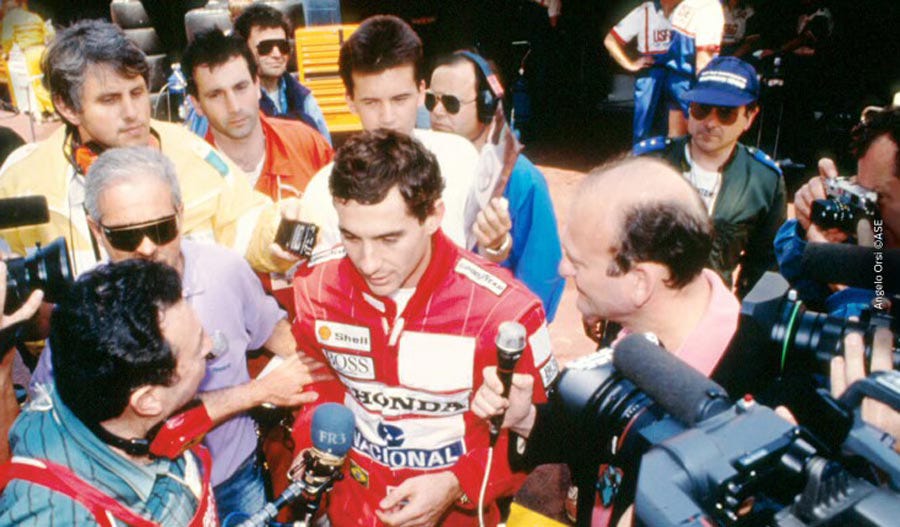
Two sorts of tragic fault seem to strike much of the media and journalism coming out of Formula One; one is a lack of complex thinking, and the other is a lack of originality. Often, they are found in a pair. Often, the latter is a consequence of the former. Rarely are they found anywhere other than on social media.
To be complex and original in thought yet coherent in writing and speech is hard, and not always needed — after all, I acknowledge that not all F1 journalists and content creators must be so thoughtful, and meme pages and parody accounts that lend themselves to humour are both valid and necessary to the health of any psuedo-sporting entertainment business. The issue that arises is in the content that only half-attempts genuine critical thinking. It is in the work that pleads for a serious audience, yet is an argument that gives me no real reason to give away my time.
The face of this superficial work remains the tiny-mic yielding influencer who has been duped into thinking that their 30-second, innocuous conversation about why ‘Landoscar’ is the new ‘Brocedes’ is the pinnacle of creative thought, or the indie YouTuber recycling the tired trope of ‘Will Max Verstappen Win Another Championship’ with no authentic perspective. This is especially harmful when you consider any intended audience; sometimes youth, sometimes casual fans, sometimes future content creators, all learning to infantilise key ideas and relationships in the sport with an unconscious adoption of a TikTok-ified vocabulary. This is not always bad, and I appreciate the work done by some to reduce complex concepts to easy-to-explain snippets, but when feigned ‘hot takes’ dominate the most influential online spaces for sporting news and culture, little space is left for considered argument and discussion.
I acknowledge that, at the worst of it, some may now label me as an internalised misogynist targeting women in sports journalism who brazenly embrace their femininity. Spare me a moment to defend myself here.
I am, and will continue to be, the first person to knock at the door of gender disparity in sports journalism and content creation. I will walk through the door in hues of pinks and pin up a list of incredibly talented women whom I genuinely look forward to seeing and reading. I have seen complex issues deconstructed by women in the most casual of tones and have listened to arguments of no fault by female TikTok creators who follow up with a ‘Paddock Fashion Guide’ afterwards. But how can one ask to be taken seriously when their portfolio is filled with uninspired reviews of race weekends in meme form? How can one complain of not receiving a journalist pass when every second post is centred around what a private WAG is up to?
Perhaps an element of this is adapting to a novel media climate, as Formula One has finally hit the market jackpot and a global audience. The release of Drive to Survive lowering the average fan age from 44 to 32, the US push by Liberty Media, and the climactic ‘F1 75’ launch event in London this year have all been perpetrators and consequences of Formula One’s growing stronghold on the world’s attention. Brands, outlets, and teams are looking for snappy influencers and voices to market their products against the backdrop of dimly lit tarmac corners. A part of me doesn’t blame these journalists and creators for producing content that appeals to the casualness of modern Formula One. But professional media remains concerned with the outspokenness in intellectual opinion and investigative work, all of which can set one apart from a now-saturated field. It might not win you passes to your favourite team’s garage, but it will have you opening up rewarding discussion and debate.
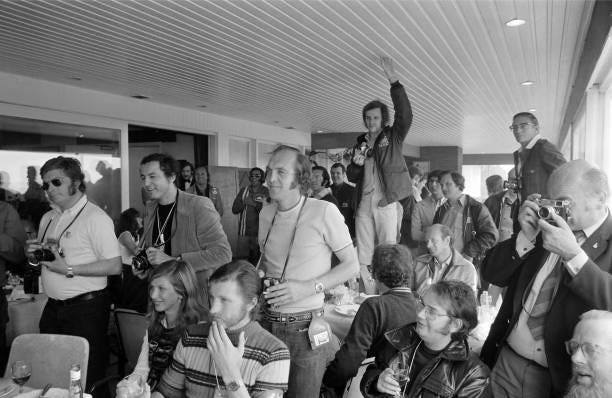
I worry that the trauma to authentic journalism is irreversible. With print media massacred, online spaces remain the only spheres of influence where writing looks for an audience. If we are now forced to compete for attention spans with short and grabby clips, we are also forced to adapt and take on the very best features of contemporary media in our work. This is how longer-form writing survives — in video essays and colourful blog articles.
I am far from the most proficient in writing about this. I am not a veteran journalist, nor a seasoned content star. I indulge in often stupid racing humour and suffer from acute wordiness and an inflated sense of ability. But I am nothing if not an observer, a social commentator with a specialty in sporting culture and sociological influence. I reserve judgments, I form opinions, I write in that long-form way I’m accustomed to. I can’t do perky TikToks, but if you can and still present a critical idea or argument, I applaud you.
And so, I urge you. Take a position; a strong one. Write proficient media. Read even better media. Read work that you really agree with. Read work that you really don’t agree with. Read. Know your audience. Will you write inoffensive and humorous work that doesn’t lend itself too seriously, or complex content that will cost you support? Or will you walk that ever-difficult line between the two in pursuit of a persona made more malleable?
The best antidote to stale thinking isn’t combat. It’s authentic work that is acutely aware of its purpose and place in today’s volatile journalistic climate. As mindful consumers of media, we are tasked with supporting and populating this gap, whether it be a short and funny TikTok on F1’s censorship issue with some gems of original and fluent thinking, or a 3000 word substack post on why the wind flaps on rear wings are a greater symbol of technical autonomy for engineers.
But, my God, at the end of it all, please give me something to fill my mind as I straighten my hair.
 Mehar Bains
Leave a comment